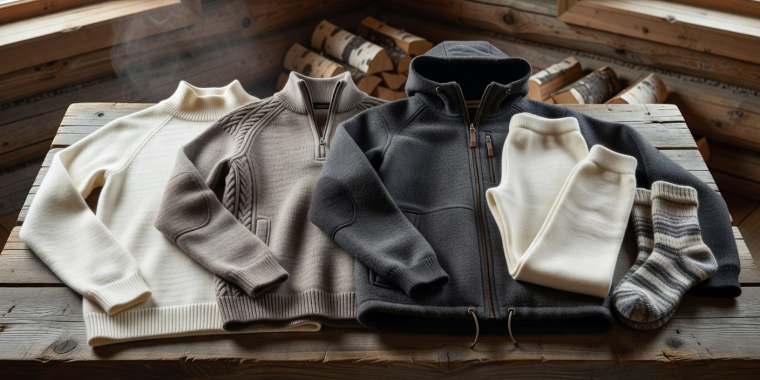
The Fundamental Physics of Next-to-Skin Regulation
In sub-zero Finland, the human body constantly releases moisture vapor even when stationary. During moderate outdoor physical exertion—such as carrying groceries over iced sidewalks or hiking through deep snow drifts—sweat production spikes dramatically. If this liquid moisture condenses against cold skin, it conducts heat away from the body 25 times faster than still air.
The cardinal rule of Finnish winter dress is the absolute elimination of pure cotton underwear and undershirts. Cotton fibers are hydrophilic; they absorb up to 27 times their own dry weight in moisture and collapse completely, trapping cold liquid against the epidermis. The result is rapid post-exertional hypothermia once movement stops.
Merino Fabric Weights (GSM) and Micron Ratings
Merino wool from selective sheep breeds is the gold standard for Arctic undergarments because each fiber possesses a microscopic crimp that creates millions of tiny air pockets. Furthermore, wool fibers absorb moisture vapor inside their cellular core while the exterior surface repels liquid droplets, generating an exothermic heat reaction as moisture is absorbed.
| Weight Class | Density (GSM) | Optimal Temperature Bracket | Target Operational Application |
|---|---|---|---|
| Ultralight | 150–180 g/m² | +5°C to -5°C | High-aerobic winter running, skate-skiing, fast snowshoeing |
| Midweight | 200–240 g/m² | -5°C to -20°C | Everyday Finnish urban transit, light hiking, forestry work |
| Expedition Heavy | 260–320 g/m² | -20°C to -45°C | Ice fishing on frozen lakes, snowmobiling, Lapland stationary watches |
Beyond weight, fiber diameter measured in microns defines comfort. Standard rough sheep wool measures 28 to 35 microns, triggering sensory nerve itch. Premium Nordic base layers specify 17.5 to 19.5 micron ultra-fine Merino, yielding silk-smooth next-to-skin contact that eliminates prickle without chemical softening agents.
Material Comparison: Pure Merino, Synthetics, and Corespun Hybrids
100% Pure Merino Wool
- Natural Antimicrobial: Wearable for 5–7 consecutive field days without odor buildup due to natural lanolin and sulfur chemistry.
- Thermoregulating: Buffers internal microclimate across temperature swings when entering heated trams or shops.
- Non-Flammable: Self-extinguishes if sparks land on it near open wilderness campfire shelters (laavu).
- Mechanical Limit: Lower tensile tear strength and slower drying times compared to high-end synthetic weaves.
Synthetic (Polypropylene / Polyester)
- Instant Dry Time: Hydrophobic plastic fibers do not absorb moisture within the filament, pushing vapor outward in minutes.
- Exceptional Durability: High abrasion resistance, standing up to hundreds of wash cycles without thinning.
- Economical Entry: Accessible cost tier for outfitting families.
- Odor Accumulation: Traps bacterial lipid secretions, requiring chemical wash additives after single intense workouts.
For modern mixed-intensity use, corespun hybrids—where fine Merino wool fibers are spun around an ultra-thin elastane or nylon filament core—offer the ideal synergy: 85% pure wool comfort with 15% reinforcement against waistband stretch and elbow friction.
Seam Geometry and Fitment Dynamics
A winter thermal base layer must maintain snug, unbroken contact across the entire torso, thighs, and calves. Any loose air bag creates a pocket where cool air circulates. Ensure the top has an extended drop-tail hem that stays securely tucked into long johns even when bending or shoveling fresh snowfall. All seams should be flatlock-stitched to avoid chafing under heavy backpack straps or tight trouser waistbands.